Logotype: a graphic mark or emblem commonly used by commercial enterprises, organizations and even individuals to aid and promote instant public recognition, most commonly referred to as a LOGO.
Numerous inventions and techniques have contributed to the contemporary logo including lithographic languages such as Egyptian Hieroglyphics, coats of arms, watermarks and the development of the printing technology.
By the 1950s an avant-garde artistic movement in Europe became an international, commercialized movement in the US and else where. The visual simplicity and conceptual clarity that were the hallmarks of Modernism formed a powerful toolset for a new generation of graphic designers.
Less is more
Modernist inspired logos proved successful and logo design has become an important area of graphic design, even though it is one of the most difficult to perfect. This is because logos are meant to represent companies brands or corpoate identities and foster their immediate customer recognition.
Logos need to be simple but able to stand out in a crowd
Five principles of effective logo design
1. Simple-easy to recognize, have something unexpected or unique
2. Memorable- keeping it simple yet appropriate
3. Timeless- will yours stand the test of time? will it still be effective in 10, 20, or 50 years?
4. Versatile- works across a variety of media and applications, is your logo still effective in color?
5. Appropriate- for the audience
full color process- CMYK (cyan, magenta, yellow and black)
spot color- method of specifying and printing colors in which each color is printed with its own ink, only effective with one, two or three colors. Pantone matching system (PMS), every printer in the world uses pantone.
Color can illicit different feelings and emotions form the audience. Color should be appropriate for the age, gender, and cultural demographics. Colors follow trends. Keep color use to a minimum, no more than three so the client doesn't have to pay as much for their logo.
combination mark- a logo that includes text and a visual that are integrated.
iconic or symbolic- more abstract, compelling yet uncomplicated images
wordmark or lettermark- logos with only text, woodmark is the full company name, lettermark is only the initials
Wednesday, April 11, 2012

Thursday, March 15, 2012
Assignment 16 research and inspiration
Research
Information graphics: graphic visual representations of information, data or knowledge, present complex information quickly and clearly, illustrate information that would be unwieldy in text form, and act as a visual shorthand.
visual communication: a conveyance of ideas in forms that can be looked upon or read
Inspiration
repetition
attention grabbing
fairly simple
who is the target audience?
the teacher
what are you trying to communicate?
the history of visual communications


I like the way the timeline is incorporated into the flying balloon. I think it makes it interesting looking.
Wednesday, March 14, 2012
Photography | 1839 - 1960s AD
Until the 1880s, how were news stories illustrated?
Engravings or woodcuts
What is a camera obscura?
A way to observe light, it projects an image of its surroundings onto a screen.
 How did scholars and artists utilize the camera obscure?
Fo safe observations of solar eclipses and the phases of the moon
From where did the photographic camera develop?
The portable box
Who first used the term "photography"? Where was is derived from?
Sir John Hershel, the greek words for light and writing
 Who is credited with making the first successful photograph?
Joseph Niepce
 Who invented the Daguerreotype process? What are the advantages and disadvantages of the process?
Daguerre, it successfully made photographs but it was expensive and the image could not be duplicated
 Who invented the Calotype process? What are the advantages and disadvantages of the process?
Talbot, it was of inferior quality but an unlimited amount of duplicates could be made
 Who invented the Wet Collodion process? What are the advantages and disadvantages of the process?
Frederich Scott Archer, exposure time was reduced to two or three seconds and the cost was less, equipment had to be portable, produced a sharper image
Post an example of a Dry Plate Process image.
 Who invented the Dry Plate process? What are the advantages and disadvantages of the process?
Richard Maddox, it used gelatin so was more portable, but still too complicated for the general public
Who is George Eastman? What company did he establish?
He made photography accessible to all by inventing roll film, the Eastman Kodak Company
 In 1888, he produced a camera that use his flexible roll film. How did he make this camera/photography accessible to the public?
He made a camera that only cost $1What is Edwin Land best known for? What company did he establish?
Patenting polarized light filters and his invention of instant photography, the Polaroid Corporation
 How long did the first Polaroid camera take to produce a photo?
60 seconds
What was Eadweard Muybridge known for?
Using multiple cameras to capture motion
 What is the Zoopraxiscope?
A device used to project a series of images in successive phases of motion
 How did Muybridge settle the debate and photograph a horse in motion?
He used a series of large cameras placed in a line each being triggered by a thread as the horse passed by In 1880s, the development of the motion picture camera allowed this?
The development of a motion picture projector
 What is a motion picture projector?
It magnifies a 'moving picture' onto a screen for an audience
Engravings or woodcuts
What is a camera obscura?
A way to observe light, it projects an image of its surroundings onto a screen.

Fo safe observations of solar eclipses and the phases of the moon
From where did the photographic camera develop?
The portable box
Who first used the term "photography"? Where was is derived from?
Sir John Hershel, the greek words for light and writing

Joseph Niepce

Daguerre, it successfully made photographs but it was expensive and the image could not be duplicated

Talbot, it was of inferior quality but an unlimited amount of duplicates could be made

Frederich Scott Archer, exposure time was reduced to two or three seconds and the cost was less, equipment had to be portable, produced a sharper image
Post an example of a Dry Plate Process image.
Richard Maddox, it used gelatin so was more portable, but still too complicated for the general public
Who is George Eastman? What company did he establish?
He made photography accessible to all by inventing roll film, the Eastman Kodak Company

He made a camera that only cost $1What is Edwin Land best known for? What company did he establish?
Patenting polarized light filters and his invention of instant photography, the Polaroid Corporation

60 seconds
What was Eadweard Muybridge known for?
Using multiple cameras to capture motion
A device used to project a series of images in successive phases of motion

He used a series of large cameras placed in a line each being triggered by a thread as the horse passed by In 1880s, the development of the motion picture camera allowed this?
The development of a motion picture projector
It magnifies a 'moving picture' onto a screen for an audience
Tuesday, March 13, 2012
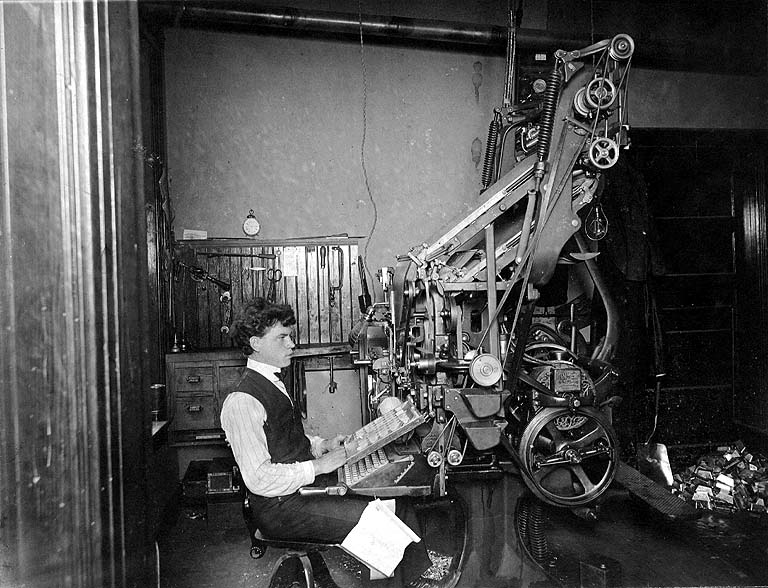
The Linotype Machine | 1886 AD

 Who is credited with the invention of the typewriter?
Christopher Sholes
What is a "stenographer"?
A person who transcribes speech, often in court cases and things similar to that.
Why did Sholes send a prototype of his typewriter to Clephane?
He believed stenographers would be the first and most important users
After the typewriter began production, why did Clephane pursue another machine?
It solved only part of his problem, it still took too long to typeset and copy the words
Who spent a year redesigning Clephane's typesetting machine?
Mergenthaler
What is meant by "typesetting"?
To arrange or generate type that is to be printed
How does the Linotype Machine differ from the typewriter?
It allowed type to be set mechanically rather than by hand
How did this machine change the newspaper industry?
It made it possible for a small number of operators to set type for more pages on a daily basis

How did the keyboard of the Linotype Machine differ from keyboards that we use today?
More spaced out, no shift key, separate upper and lower case letters, different arraignment of keys

A mold for letter forms
Why is the Linotype Machine the greatest advanced in printing since movable type?
It became a worldwide advancement in type and changed the typing industry
Sunday, March 11, 2012
The Gutenberg Press | 1450 AD
What is Johannes Gutenberg credited with?
The printing press
How did the printing press work?
A hand press in which ink was written over the raised surface of movable hand set block letters held within a wooden form. The form was then pressed against a sheet of paper
What motivated Gutenberg to find a better way of creating books?
His love of reading and working in the mint
Why did Gutenberg experiment with metal type versus wood type?
Wood was not as durable

What is moveable type?
metal type, the system of printing that uses movable components to reproduce the elements of a document
What is a matrix?
A mold that creates a letter in a book
What ink did Gutenberg develop that he used specifically for the printing press?
An oil based ink
What is paper made from? Where did paper originate?
Wood pulp and china
What is a "substrate"?
The base material that images were printed onto
Who did Gutenberg seek to help with the invention of the press? Close to the end of the 5 years, what happened?
Fust and gutenberg was sued by fust and had to give him all of his materials and books he had produced
What was the first book he printed?Bible.

How did the Gutenberg Press impact communication?
perfected script, books were made more rapidly, current information could be shared locally and around the world, the cost of books decreased, the population became more litterate, etc.
 Who introduced the printing press to England?
William Caxton
What was the early form of newspapers?
Trade news letters
When was the first news weekly published? What was it called?
1704, the boston letter
What kind of press was built in the US in the mid 1800s?
the steam powered rotary press
By the late 1930s, presses had increased in efficiency and were capable of 2,500 to 3,500 impressions per hour. What is meant by "impression"?
The type is put on the page
Which printing process is the Gutenberg press an example of? Briefly describe the process?
Releif printing, movable type is placed onto the press. Ink is spread onto to the type. Papaer is placed on top. The press applies pressure to transfer the ink onto the press.
 What is intaglio printing and how is ink transferred?
A way of printing and the image area is etched into the plate surface to hold the ink.
What is porous printing and how is ink transferred?
A basic stencil process, and ink is forced through open mesh in areas.

What is lithography and how is ink transferred?
planograpy, and it is forced into designs by water
 What variation of lithography is used by the commercial printing industry today?
Offset lithograpy
How do printing presses used today compare to the Gutenberg Press?
They are far more advanced and able to do much more faster
Describe four-color process printing using CMYK?
Cyan, magenta, yellow, black
The printing press
How did the printing press work?
A hand press in which ink was written over the raised surface of movable hand set block letters held within a wooden form. The form was then pressed against a sheet of paper
What motivated Gutenberg to find a better way of creating books?
His love of reading and working in the mint
Why did Gutenberg experiment with metal type versus wood type?
Wood was not as durable
What is moveable type?
metal type, the system of printing that uses movable components to reproduce the elements of a document
What is a matrix?
A mold that creates a letter in a book
What ink did Gutenberg develop that he used specifically for the printing press?
An oil based ink
What is paper made from? Where did paper originate?
Wood pulp and china
What is a "substrate"?
The base material that images were printed onto
Who did Gutenberg seek to help with the invention of the press? Close to the end of the 5 years, what happened?
Fust and gutenberg was sued by fust and had to give him all of his materials and books he had produced
What was the first book he printed?Bible.
How did the Gutenberg Press impact communication?
perfected script, books were made more rapidly, current information could be shared locally and around the world, the cost of books decreased, the population became more litterate, etc.
 Who introduced the printing press to England?
William Caxton
What was the early form of newspapers?
Trade news letters
When was the first news weekly published? What was it called?
1704, the boston letter
What kind of press was built in the US in the mid 1800s?
the steam powered rotary press
By the late 1930s, presses had increased in efficiency and were capable of 2,500 to 3,500 impressions per hour. What is meant by "impression"?
The type is put on the page
Which printing process is the Gutenberg press an example of? Briefly describe the process?
Releif printing, movable type is placed onto the press. Ink is spread onto to the type. Papaer is placed on top. The press applies pressure to transfer the ink onto the press.
 What is intaglio printing and how is ink transferred?
A way of printing and the image area is etched into the plate surface to hold the ink.
What is porous printing and how is ink transferred?
A basic stencil process, and ink is forced through open mesh in areas.
What is lithography and how is ink transferred?
planograpy, and it is forced into designs by water
 What variation of lithography is used by the commercial printing industry today?
Offset lithograpy
How do printing presses used today compare to the Gutenberg Press?
They are far more advanced and able to do much more faster
Describe four-color process printing using CMYK?
Cyan, magenta, yellow, black
The Codex and the Illuminated Manuscript | 1st century AD

What were the drawbacks of the scroll?
The reader must read the text in the order it was written. Post an example of a codex.

A covered and bound collection of hand written pages.
"Codex" is derived from the Latin meaning "block of wood". Why?
What is the difference between "sequential access" and "random access"?
In random access one can go to any point to find information in sequential access one has to go in order.
What were the advantages of using the codex?
It had random access and was more portable along with being easier to use in organizing libraries because the title could be written on the spine.
What helped spread the use of the codex?
The rise of christianity
What replaced papyrus? Describe the process used to create it?
Parchment paper, hair and fat was removed and skin was smoothed out, it was then soaked in water, calcium, flour and salt were added, and lastly the skin was stretched out, flattened and dried.
What is vellum?
A finer quality parchment
Name several examples of current technology that utilizes the format of the codex?
New technology like the kindle mimic the experience of reading a book even though it is an electronic.
What led to a period of cultural and economical deterioration?
The decline of the roman empire

Who began creating books by hand, taking the creation to an art form?
Monks
What does "illumination" refer to? What was included in this ornamentation?
The borders, illistrations, and ornamentation added to each page, intials of chapeters, and paintings in the margins of the page
What tool was used for creating the illuminated manuscripts?
Natural quill pens
Why were these manuscripts reserved for religious purposes?
The work was extremely laborous
What is craftsmanship? Why is it important?
Skill in an ocupation or trade, and it is important becuase it gives us great works of art like the illuminated manuscripts
Monday, March 5, 2012
Assignment #15 Research and Inspiration
Research
Illuminated Manuscript: an extremely decorative book created by monks. Mostly used for religious purposes.
Inspiration
ornate
pretty
attention grabbing
Who is the target audience?
My teacher
What are you trying to communicate?
A large starting letter and a decorative border

I like the starting letter and the colors used. It has a very appealing complex border.
 I like the 3D effect the bottom of the page has and the extremely decorative border.

I like the fancy swirls around the I.

the poca dot background works well with the swirls that work well with the A.
Illuminated Manuscript: an extremely decorative book created by monks. Mostly used for religious purposes.
Inspiration
ornate
pretty
attention grabbing
Who is the target audience?
My teacher
What are you trying to communicate?
A large starting letter and a decorative border

I like the starting letter and the colors used. It has a very appealing complex border.


I like the fancy swirls around the I.

the poca dot background works well with the swirls that work well with the A.
Subscribe to:
Posts (Atom)